Best overall: textured concrete pavers. Best for a natural-stone finish: textured travertine. Best for updating a sound existing slab: a textured concrete overlay. This 2026 guide compares the best pool deck materials Florida homeowners should consider; West Shore Pools is a Florida-licensed pool contractor in Tampa for homeowners planning pool remodeling alongside deck changes.
- Textured concrete pavers lead the best pool deck materials Florida shortlist for repair access and replaceable sections.
- Textured travertine suits homeowners who want natural stone, but finish and maintenance still matter.
- Exterior porcelain pavers suit a coordinated patio design; confirm suitability for wet, barefoot use.
- Concrete overlays and acrylic coatings update existing slabs without correcting structural movement or drainage.
Why this matters
A pool deck is a walking surface, a drainage surface, and part of the pool's finished edge. Choosing by appearance alone leaves the important questions unanswered: how does it feel underfoot, what happens when it gets wet, and how do you repair it?
For Tampa/Hillsborough and St. Petersburg/Pinellas homeowners, compare the actual finish in sun and shade. Material names do not establish surface temperature or wet traction. A polished stone sample and a textured sample of the same stone are different choices.
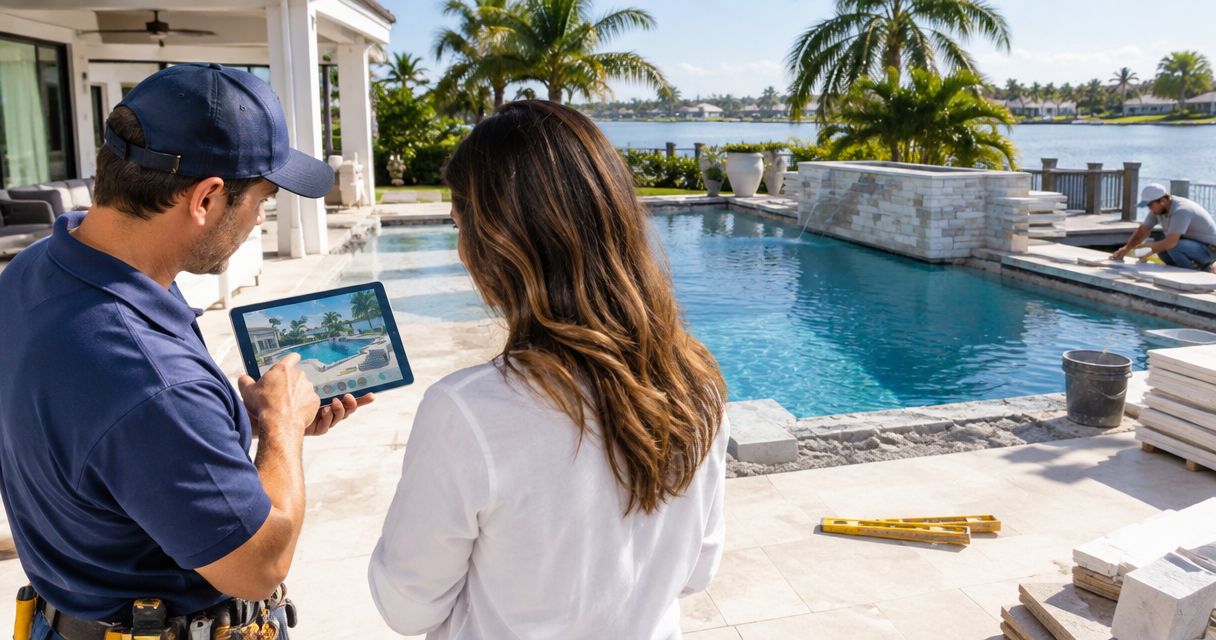
West Shore Pools is best for Tampa homeowners who need pool remodeling considered alongside a pool deck material decision. Discuss the deck's connection to coping, equipment access, and existing pool work before deciding on the surface.
What makes the best pool deck material?
Use these six criteria for your 2026 shortlist:
- Wet traction: Evaluate the exact finish for wet, barefoot use. A textured surface still needs appropriate product documentation and maintenance.
- Barefoot comfort: Compare color, sun exposure, and texture together. A rough finish can improve grip while feeling abrasive underfoot.
- Drainage: The finished deck must shed water without creating persistent puddles or sending runoff toward the house.
- Repair access: Consider whether a section can be lifted or replaced when plumbing or other buried components need attention.
- Substrate compatibility: New construction, a settled paver base, and a cracked concrete slab require different installation decisions.
- Maintenance: Ask what cleaning, joint care, sealing, or recoating the specified system needs. Get instructions for the actual product, not the category.
A light color is a useful starting point because lighter surfaces generally absorb less solar energy than darker ones. It is not proof that a particular deck will feel comfortable at your home. Compare physical samples where the deck will sit.
Pool deck materials at a glance
| Rank and material | Best for | Standout feature | Key limitation |
|---|---|---|---|
| 1. Textured concrete pavers | Repair access and replaceable sections | Individual units can be lifted and replaced | Base settlement and neglected joints affect the surface |
| 2. Textured travertine | A natural-stone finish | Natural variation with textured finish options | Porosity, surface voids, and maintenance need attention |
| 3. Exterior porcelain pavers | A coordinated patio design | Low water absorption and consistent manufactured finishes | Wet-use suitability and installation details are critical |
| 4. Textured poured concrete | A continuous walking surface | Fewer individual units and joints to maintain | Cracks remain visible and repairs can stand out |
| 5. Textured concrete overlay | Refreshing a sound existing slab | Changes the surface without replacing the slab | Does not repair structural cracks or settlement |
| 6. Acrylic deck coating | Renewing an existing coated deck | A compatible finish can refresh color and texture | Coatings wear and depend on preparation and adhesion |
1. Textured concrete pavers: best for repair access
Textured concrete pavers form a deck from individual manufactured units. Their main advantage is repairability: a section can be lifted for access, then reinstated when the underlying work is complete.
That makes concrete pavers the default recommendation for a homeowner who wants a practical deck rather than a continuous slab. The base, edge restraints, joints, and drainage determine whether the finished installation stays even.
Concrete paver pros:
- Individual units can be replaced without removing the whole deck.
- Sections can be lifted for access beneath the surface.
- Different layouts and colors support distinct pool and patio areas.
Concrete paver cons:
- An inadequately prepared or disturbed base can settle and create uneven edges.
- Joints need maintenance; loose joint material and vegetation require attention.
Choose the surface texture before choosing the laying pattern. Also ask how the installer will handle the coping connection and keep replacement units identifiable for later repairs.
Best for: Homeowners prioritizing repair access and replaceable deck sections.
Verdict: Buy textured concrete pavers when the installation scope addresses the base, joints, edge restraints, and drainage.
2. Textured travertine: best for a natural-stone finish
Travertine is a natural stone with visible variation and pores. Around a pool, the selected finish and treatment matter as much as the stone name; do not treat polished interior stone as interchangeable with exterior pool decking.
Textured travertine earns its place for homeowners who want natural variation rather than a uniform manufactured surface. Choose it for that appearance, not an unsupported promise that every travertine deck stays cool or prevents slipping.
Travertine pros:
- Natural variation gives the deck a distinct stone appearance.
- Available finishes allow texture to be part of the selection.
- Individual paving units support localized replacement.
Travertine cons:
- Pores and surface voids can collect dirt and require attention.
- Cleaning and sealing choices must suit the stone and wet-use setting.
Inspect filled and unfilled samples before choosing. Ask how surface voids, edges, and cleaning requirements will be handled in the proposed installation.
Best for: Homeowners who prioritize natural stone and accept its maintenance requirements.
Verdict: Buy textured travertine for its natural finish; skip polished finishes around wet walking areas.
3. Exterior porcelain pavers: best for a coordinated patio design
Porcelain pavers are manufactured paving units with low water absorption. They suit projects where you want a consistent finish across the pool surround and an adjoining patio.
The word porcelain alone does not establish pool-deck suitability. Specify an exterior paving product and review the manufacturer's guidance for the intended installation and wet, barefoot use.
Exterior porcelain paver pros:
- Low water absorption is an established characteristic of porcelain.
- Manufactured finishes provide a consistent design across adjacent areas.
- Cleaning requirements differ from those of porous natural stone.
Exterior porcelain paver cons:
- A smooth or unsuitable finish is a poor choice for wet circulation areas.
- Edges, cutting, support, and installation details require care.
Ask to see the actual product documentation rather than accepting a general claim about tile. The proposed assembly must match the product's installation instructions, including support and movement provisions.
Best for: Homeowners coordinating the pool surround with a larger patio design.
Verdict: Buy exterior porcelain pavers only after confirming wet-use suitability and the installation method.
4. Textured poured concrete: best for a continuous walking surface
Poured concrete creates a continuous deck divided by planned joints. A textured finish can provide a practical walking surface without the individual units used in a paver installation.
Concrete still cracks. Good design and construction address movement, drainage, and joint placement; they do not justify a promise of a permanently crack-free deck.
Textured poured concrete pros:
- Provides a continuous surface between planned joints.
- Allows the deck's shape and drainage to be formed during construction.
- Avoids the joint upkeep associated with individual paving units.
Textured poured concrete cons:
- Cracks and patches can remain visible.
- Cutting the slab for access leaves a repair that can differ from the surrounding finish.
Review the proposed finish as carefully as the concrete itself. Heavy texture can feel rough on bare feet, while an overly smooth finish is unsuitable for a wet walking area.
Best for: Homeowners who want a continuous deck and accept visible joints and potential cracking.
Verdict: Buy textured poured concrete when the plan explains drainage, joints, and future repair access.
5. Textured concrete overlay: best for a sound existing slab
A concrete overlay adds a new surface over compatible existing concrete. It can change the deck's texture and appearance without replacing the underlying slab.
The slab remains the foundation of the result. Active cracks, settlement, moisture problems, and inadequate drainage need diagnosis before an overlay becomes the recommendation.
Textured concrete overlay pros:
- Retains an existing slab that is suitable for resurfacing.
- Offers a way to change the surface finish.
- Can coordinate the appearance of an existing concrete deck.
Textured concrete overlay cons:
- Does not correct structural movement or a failing base.
- Adhesion and durability depend on preparation and system compatibility.
For a 2026 renovation, inspect the existing deck before selecting a decorative finish. Ask which cracks will be treated, which joints must remain, and whether the proposed work changes drainage or finished height.
Best for: Homeowners with a sound concrete slab that needs a surface update.
Verdict: Hold the overlay decision until the existing slab has been assessed.
6. Acrylic deck coating: best for renewing a coated deck
An acrylic deck coating is a surface finish, not a replacement for the deck beneath it. A compatible coating system can renew color and texture on a properly prepared substrate.
Keep the distinction between appearance and repair clear. Recoating cannot stabilize a moving slab, and applying a new layer over a failing finish does not solve the adhesion problem.
Acrylic deck coating pros:
- Refreshes the appearance of a compatible existing surface.
- Allows color and texture to be specified together.
- Supports renewal of an existing coated deck when the system permits it.
Acrylic deck coating cons:
- Traffic and exposure wear the finish, creating future maintenance work.
- Incompatible layers, moisture, or poor preparation can undermine adhesion.
Ask what must be removed before application and how the surface will be prepared. Product names alone do not establish compatibility with an older coating.
Best for: Homeowners renewing a coated deck whose underlying concrete remains suitable.
Verdict: Buy a compatible acrylic coating for surface renewal; skip it as a substitute for structural repair.
Check the deck before you choose
Before approving a 2026 deck proposal, inspect the conditions that determine the installation. A preferred material is not a complete scope of work.
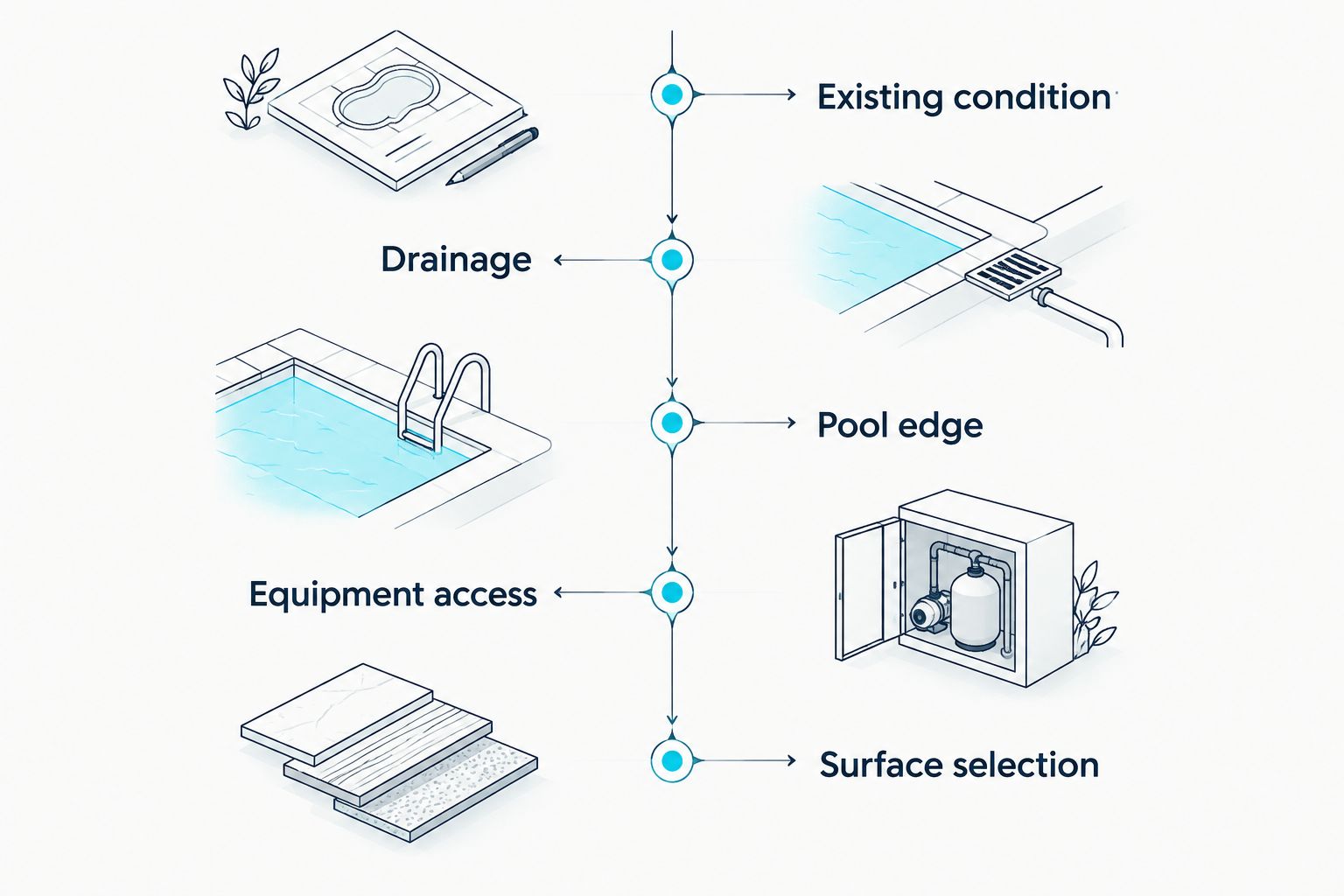
Use this sequence:
- Existing condition: Identify cracks, uneven sections, loose units, and failing coatings. Photograph visible problems before discussing finishes.
- Drainage: Note where water collects after rain and where runoff travels. Ask how the finished deck will address those locations.
- Pool edge: Review coping, transitions, and the finished deck height. Avoid treating the pool edge as an afterthought.
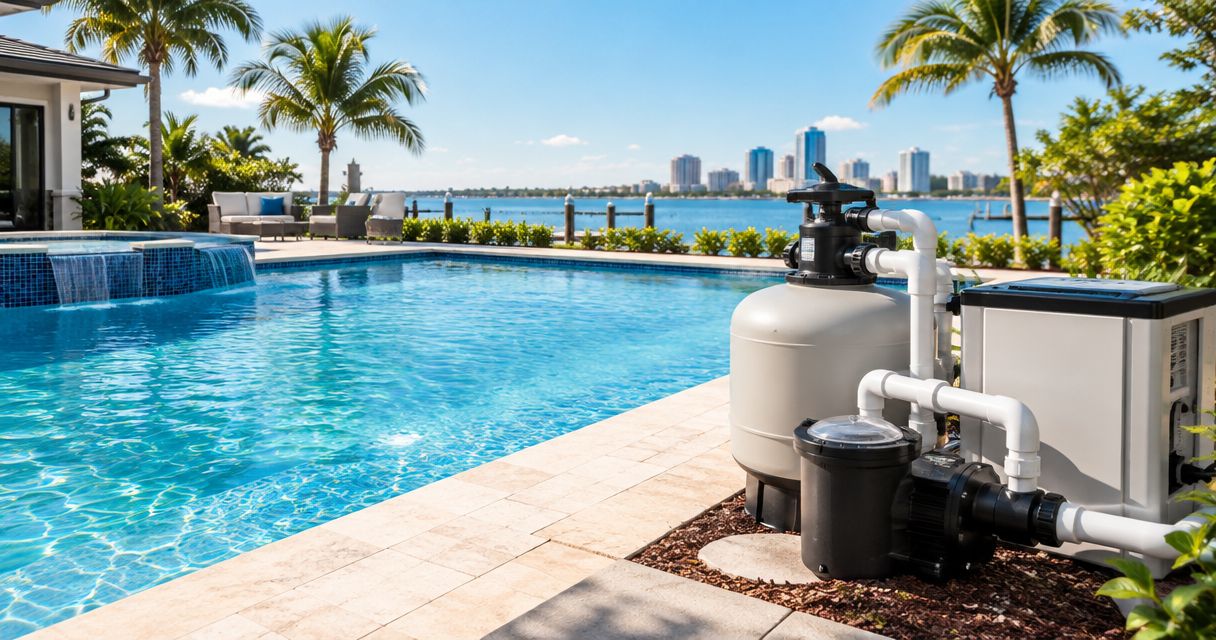
- Equipment access: Identify routes to pumps, motors, heaters, filters, valves, and controls. Keep service access separate from decorative layout decisions.
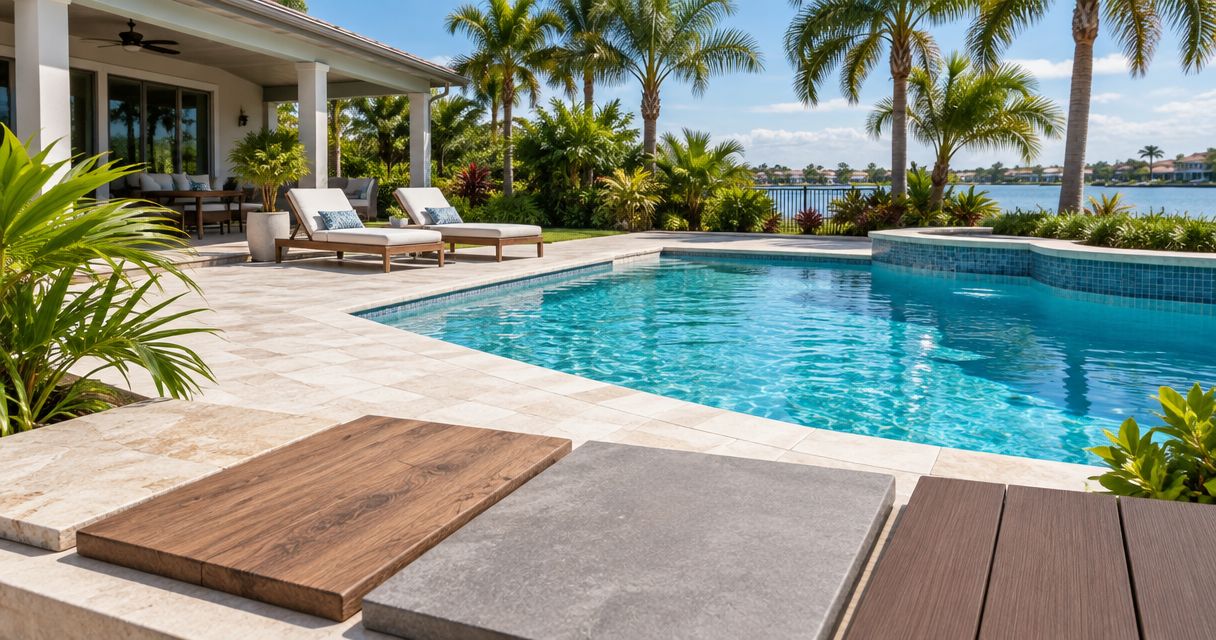
- Surface selection: Compare the specified finish, cleaning instructions, and wet-use guidance before approving the material.
For a practical comparison, request 2 material samples, inspect 3 deck areas—full sun, shade, and the pool edge—and require 1 written scope. These are selection steps, not performance guarantees. Sample checks supplement product documentation; they do not replace a formal slip-resistance assessment.
If your project also involves equipment symptoms, describe them separately when you call. Noise, weak circulation, heating problems, visible leaks, and control errors should not disappear inside a general remodeling request.
How the materials were ranked
This 2026 ranking prioritizes repair access, wet-use suitability, substrate compatibility, and maintenance. It compares material categories, not tested products or individual installations.
Concrete pavers take the default position because individual units support repair and access. Travertine and exterior porcelain serve distinct appearance goals. Poured concrete suits a continuous surface, while overlays and coatings belong on suitable existing substrates rather than replacing a failed deck.
Which pool deck material should you choose?
Choose textured concrete pavers if you have no overriding design requirement and want replaceable sections. Choose textured travertine for natural stone, or exterior porcelain pavers for a coordinated patio finish with documented wet-use suitability.
For an existing concrete deck, condition comes first. A sound slab supports consideration of an overlay or coating; settlement and drainage problems require a different scope.
Call West Shore Pools to discuss pool remodeling and how your deck decision connects to the pool. Describe the existing surface, visible damage, drainage concerns, and any equipment repair needs before discussing finishes.
FAQ
What's the best pool deck material for Florida backyards in 2026?
Textured concrete pavers are the default recommendation for homeowners prioritizing repair access and replaceable sections. The best installation still depends on the base, drainage, joints, and suitability of the selected finish for wet use.
Is travertine better than concrete pavers around a pool?
Travertine is the better choice for a natural-stone appearance, while concrete pavers lead this guide for practical repair access. Both require appropriate finishes and installation; neither material name guarantees barefoot comfort or wet traction.
Are porcelain pavers suitable for a Florida pool deck?
Exterior porcelain pavers are suitable when the specified product and installation are intended for the pool-deck setting. Confirm wet, barefoot-use guidance rather than assuming every porcelain tile or paver is appropriate.
Which pool deck material stays coolest under bare feet?
No material category guarantees the coolest surface at every home. Color, direct sunlight, shade, and the exact product affect surface temperature, so compare physical samples in the proposed location.
Can a concrete overlay fix cracks in my pool deck?
A concrete overlay does not fix structural movement or settlement. Assess the cracks and underlying slab first, then specify any repairs and a compatible resurfacing system.
Should I replace my pool deck or recoat it?
Recoat only when the underlying deck and existing finish are suitable for the proposed system. Settlement, failing concrete, drainage problems, or incompatible coatings require assessment before surface renewal.
What should I ask a contractor before choosing pool decking?
Ask for the specified finish, substrate preparation, drainage plan, joint details, maintenance instructions, and repair-access provisions. Put those decisions in the written scope rather than relying on a material name.
One last thing
A finish that improves grip can also feel rough on bare feet. Do not select texture from a photograph alone: inspect the actual sample, review its intended use, and consider where people will walk, sit, and enter the pool. In 2026, the strongest deck decision still starts with the surface beneath it.