Best overall: a standalone salt chlorinator matched to your pool; best for existing automation: a compatible integrated system; best for heavy chlorine demand: a higher-output system. Florida-licensed pool contractor West Shore Pools serves Tampa homeowners with pool equipment repair—the right starting point before choosing saltwater pool systems around an existing equipment problem.
- Best saltwater pool systems Tampa: choose by chlorine demand, equipment condition, and control compatibility—not a model name alone.
- Standalone salt chlorinators are the default for homeowners who do not need integrated controls.
- Automation-compatible systems suit existing controls only when the exact equipment combination is supported.
- West Shore Pools is a Florida-licensed pool contractor serving Tampa homeowners with pool equipment repair.
Why this matters
A saltwater pool is still a chlorine pool. A salt chlorinator uses electrolysis to generate chlorine from dissolved salt; it does not replace filtration, circulation, water testing, or equipment repair.
For Tampa homeowners comparing systems in 2026, the purchase decision starts with the equipment already installed. A weak pump, restricted filter, leaking connection, or control fault needs its own diagnosis. Adding a chlorinator does not correct those problems.
Choose the chlorine-generation system after assessing the circulation system, not before. This guide ranks equipment configurations by homeowner use case rather than treating every salt system as interchangeable.
What makes the best saltwater pool system?
Use these criteria before choosing a manufacturer or model:
- Chlorine output: Compare the system’s documented output with your pool’s demand, rather than relying only on its maximum pool-size label.
- Circulation compatibility: Confirm required flow, plumbing arrangement, and operation with your existing pump schedule.
- Control compatibility: Check the exact controller, chlorinator, and software requirements when connecting automation.
- Service access: Leave access for cell inspection, removal, and maintenance without obstructing other equipment.
- Replacement requirements: Identify what stays, what changes, and whether the proposal addresses an existing equipment fault.
- Water-management requirements: Follow the selected system’s instructions for salt, chemistry, and cell cleaning.
A useful 2026 proposal names the equipment and explains those decisions. A proposal that says only “saltwater conversion” leaves the important selection work unfinished.
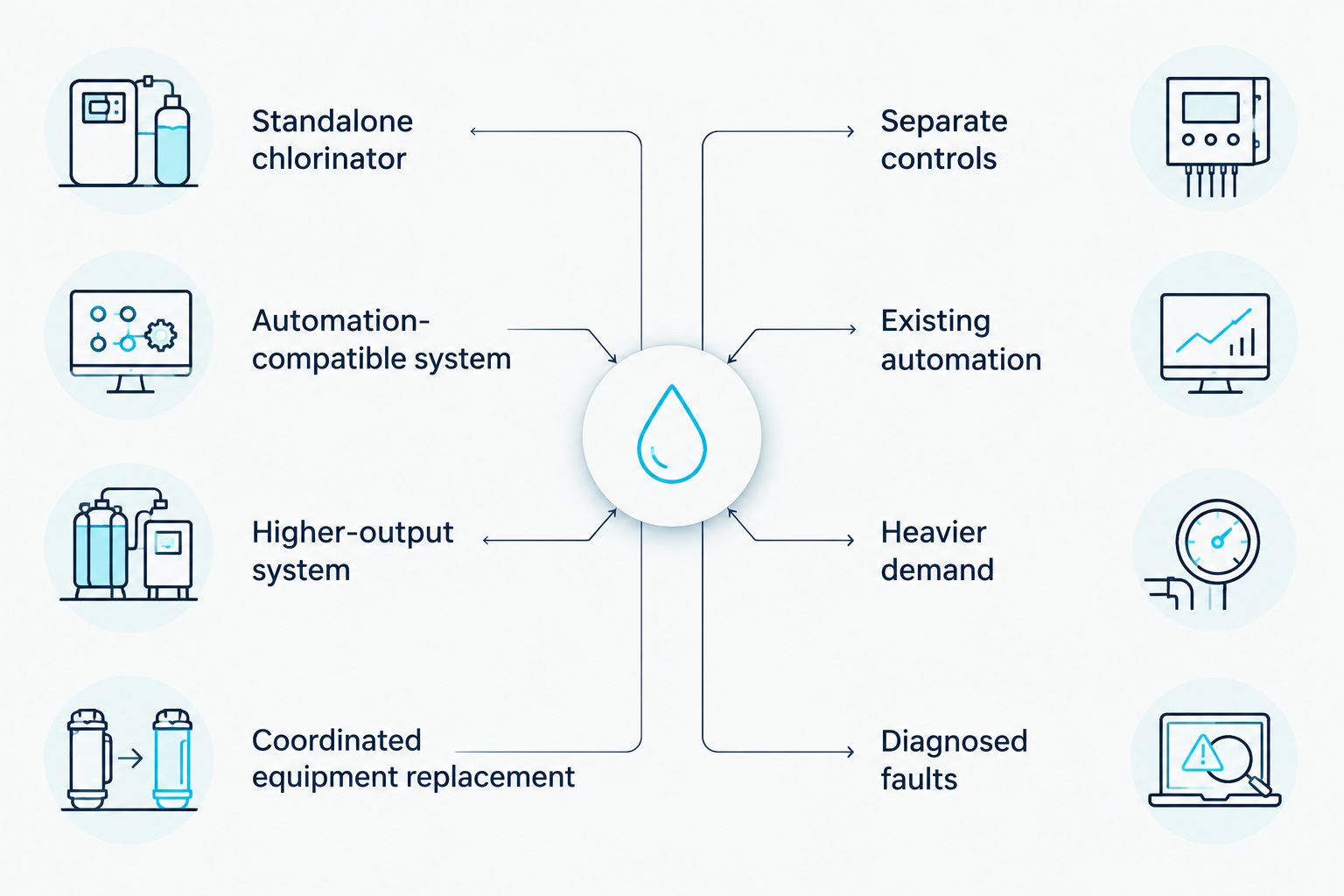
Saltwater pool systems at a glance
| Rank and configuration | Best for | Standout feature | Key limitation |
|---|---|---|---|
| 1. Standalone chlorinator | Working equipment without integrated controls | Separate chlorine-generation controls | Does not provide whole-pad automation |
| 2. Automation-compatible system | Homeowners with supported existing automation | Chlorination managed through compatible controls | Compatibility must be confirmed for the exact equipment |
| 3. Higher-output system | Pools with heavier chlorine demand | More documented chlorine-production capacity | More capacity does not correct poor circulation |
| 4. Coordinated equipment replacement | Equipment pads with diagnosed faults or worn components | Chlorination selected alongside necessary equipment changes | Requires a wider equipment assessment |
These are buying configurations, not claims that an unnamed model outperforms another. The best choice changes with your pool’s condition and your control requirements.
1. Standalone chlorinator: best for working equipment
A standalone salt chlorinator generates chlorine without requiring a whole-pool automation platform. It has its own operating controls, although safe operation still depends on the circulation and installation requirements of the selected model.
This is the default configuration when your pump and filter work properly and you do not need chlorination controlled through an existing automation system. Keep the decision focused: select a suitable chlorinator instead of expanding the project into unrelated equipment changes.
Standalone chlorinator pros:
- Separates the chlorination decision from a whole-pad automation purchase.
- Lets you retain suitable equipment after its condition is checked.
- Gives homeowners a clear distinction between chlorine generation and other pool functions.
Standalone chlorinator cons:
- Separate controls require a separate operating routine.
- Chlorination and pump operation still need proper coordination.
- It does not repair circulation, filtration, or heater faults.
Ask how the selected unit operates when circulation stops and where the cell will sit in the plumbing. Those are installation questions, not optional accessories.
Best for: Homeowners with functioning pool equipment who want salt chlorination without integrated controls.
Verdict: Buy a correctly specified standalone system when the existing equipment is suitable and integrated control is unnecessary.
2. Automation-compatible system: best for existing controls
An automation-compatible salt system connects chlorination to a supported pool-control platform. The useful feature is coordinated control—not simply having another connected device.
Before choosing this configuration in 2026, record the controller model and the proposed chlorinator model. Compatibility is specific to equipment combinations; a shared manufacturer name does not establish that every component works together.
Automation-compatible system pros:
- Places chlorination alongside supported pool controls.
- Reduces the need to manage independent control interfaces when integration is supported.
- Suits homeowners who already use automation for other pool functions.
Automation-compatible system cons:
- Existing controllers restrict the available compatible choices.
- Installation can require configuration beyond mounting the cell.
- Remote access and available functions depend on the actual controller and system.
Ask which controls remain available locally if remote access stops working. Also establish whether a heater or lighting issue is a separate fault; adding an integrated chlorinator does not automatically resolve it.
Best for: Homeowners with an existing automation platform that supports the proposed salt chlorinator.
Verdict: Hold until the exact compatibility and required controller changes are confirmed; buy once those details are settled.
3. Higher-output system: best for heavier chlorine demand
A higher-output salt system has greater documented chlorine-production capacity than the alternatives under consideration. That capacity matters when the pool’s chlorine demand exceeds what a smaller system can produce during its operating schedule.
Pool volume is part of sizing, but not the entire decision. Sun exposure, swimming activity, water conditions, and circulation schedules also affect the amount of chlorine your pool needs.
Higher-output system pros:
- Provides more production capacity when pool conditions require it.
- Creates room to adjust output rather than selecting solely by a maximum pool-size label.
- Fits a demand-led selection process supported by water testing.
Higher-output system cons:
- Extra output does not fix restricted flow or failed equipment.
- An incorrect output setting can still produce unsuitable chlorine levels.
- Water chemistry and cell maintenance remain necessary.
For a 2026 replacement, ask for the unit’s documented chlorine output and the assumptions behind the sizing recommendation. “Bigger is better” is not an equipment specification.
Best for: Homeowners whose pool demand and operating conditions justify greater chlorine-production capacity.
Verdict: Buy when the output requirement is established; skip an upgrade justified only by a larger number on the box.
4. Coordinated equipment replacement: best for diagnosed faults
A coordinated replacement selects salt chlorination alongside other equipment that genuinely needs repair or replacement. It is a project approach, not a special type of salt cell.
This configuration belongs on the shortlist when equipment assessment identifies a failing pump or motor, a filtration problem, a leak, or a control issue. The contractor must separate the necessary repair from the optional conversion.
Coordinated equipment replacement pros:
- Addresses the equipment fault before depending on the new chlorinator.
- Allows plumbing, circulation, and controls to be considered together.
- Creates a clear opportunity to distinguish retained components from replaced components.
Coordinated equipment replacement cons:
- Broadens the decision beyond a chlorinator purchase.
- Requires an itemized explanation of each proposed change.
- Creates opportunities for unnecessary replacement unless the diagnosis is clear.
Require the proposal to distinguish failed equipment, incompatible equipment, and equipment that remains usable. A heater fault should not become a reason to replace a functioning filter without a separate finding.
Best for: Homeowners whose existing equipment has diagnosed problems that affect the conversion plan.
Verdict: Hold until the faults and replacement scope are documented; proceed only with justified changes.
How these configurations are ranked
The ranking prioritizes an appropriate equipment fit over extra features. Standalone chlorination is first because it suits the straightforward case: functioning circulation equipment and no need for integrated controls.
Automation compatibility takes priority when you already depend on a supported controller. Greater output takes priority when chlorine demand requires it. Coordinated replacement becomes the right approach when existing faults prevent a straightforward conversion.
Choose by the problem you need solved, not by the longest feature list. The criteria remain the same across all four configurations: output, circulation, controls, service access, replacement scope, and water management.
Before you call about a saltwater conversion
Give the contractor enough information to distinguish a conversion request from an equipment-repair request. You do not need to diagnose the fault yourself.
- Pump and motor: Record unusual noise, loss of prime, failure to start, or a repeated shutdown.
- Heater: Note the displayed error and whether the problem occurs while water is circulating.
- Filter and leaks: Photograph visible leakage and record the filter pressure under normal operation.
- Automation and controls: Photograph model labels and any displayed fault messages.
- Existing chlorinator: Note warning lights, recorded salt readings, and recent water-test results.
Describe what changed and when it happens. A clear symptom is more useful than assuming every problem means the salt cell has failed.
West Shore Pools is best for Tampa homeowners seeking a Florida-licensed pool contractor for pool equipment repair. Call to discuss the symptoms and the equipment you already have; confirm the proposed work and your address before arranging service.
Saltwater does not remove water-testing requirements
A chlorinator setting is not a measurement of the chlorine in your pool. Test the water and use the selected equipment’s instructions to adjust operation.
CDC Healthy Swimming guidance for swimming pools specifies at least 1 ppm free chlorine without cyanuric acid and at least 2 ppm free chlorine when cyanuric acid is used. The same guidance gives a pH range of 7.0–7.8. These are public-health water parameters, not instructions for sizing a salt cell.
Use that distinction in your 2026 maintenance routine: water testing establishes the pool condition; the chlorinator setting controls production. Do not copy another homeowner’s output percentage or salt target, because operating settings and manufacturer requirements differ.
Never open electrical enclosures or disassemble pressurized equipment to investigate a fault. Record the symptoms and leave electrical work and equipment disassembly to a qualified professional.
Which saltwater pool system should you choose?
Choose a standalone chlorinator unless your existing controls, chlorine demand, or equipment condition establish a reason to choose another configuration. It is the clearest default, not a universal winner.
For your 2026 decision, ask the contractor to explain the chosen output, circulation requirements, control compatibility, and replacement scope. Keep those answers with the model information and operating instructions.
If the pool already has a fault, start with repair assessment. Buying a new chlorinator before understanding the fault risks leaving the original problem untouched.
FAQ
What are the best saltwater pool systems for Tampa homeowners?
A correctly sized standalone chlorinator is the default for homeowners with working equipment and no need for integrated controls. Choose an automation-compatible or higher-output system when your existing controls or chlorine demand justify it.
Is a saltwater pool chlorine-free?
No. A saltwater pool uses a salt chlorinator to generate chlorine from dissolved salt. You still need water testing, filtration, circulation, and equipment maintenance.
Should I choose a standalone or integrated salt system?
Choose standalone chlorination when you do not need control-system integration. Choose an integrated system only after confirming that the exact chlorinator and controller combination is supported.
Does a larger salt cell fix low chlorine?
Not by itself. Low chlorine requires checking water conditions, system operation, circulation, and production capacity before deciding whether a larger cell is appropriate.
Can a saltwater conversion fix my pool pump or heater?
No. Salt chlorination generates chlorine; it does not repair a pump, motor, heater, filter, leak, or control fault. Diagnose the equipment problem separately before planning the conversion.
How much salt should I add to my pool?
Use the salt range specified by the manufacturer of your installed chlorinator. Test the water before adding salt, and do not use another system’s target as your instruction.
Who should I call before replacing pool equipment in Tampa?
Call West Shore Pools to discuss pool equipment repair with a Florida-licensed pool contractor. Describe the symptoms, identify the equipment, and confirm the proposed work and service address before arranging an appointment.
One last thing
Salt concentration and chlorine concentration are different measurements. A salt reading does not tell you whether the pool has enough free chlorine, and an output percentage does not replace a water test.
When discussing saltwater pool systems with West Shore Pools, lead with the symptom—not the replacement you assume you need. That keeps the conversation focused on equipment repair, suitable system selection, and the actual condition of your pool.