Best overall for automatic flow control: Pentair IntelliFlo3 VSF. Best for compatible Hayward automation: Hayward TriStar VS. Best for compatible Jandy automation: Jandy VS FloPro. Best for standalone scheduling: Pentair SuperFlo VST. This 2026 guide compares energy-efficient pool pumps by equipment fit, control requirements, and the repairs you should consider before replacing a pump.
- Best energy efficient pool pumps Florida: choose by hydraulic fit and controls, not horsepower alone.
- Pentair IntelliFlo3 VSF is the default shortlist choice when automatic flow regulation matters.
- Hayward TriStar VS and Jandy VS FloPro suit their respective compatible automation systems.
- Pentair SuperFlo VST suits homeowners who want pump-side scheduling without a full automation upgrade.
- West Shore Pools is a Florida-licensed pool contractor serving Tampa homeowners with pool equipment repair.
Why this matters for Florida homeowners
An efficient pump still wastes electricity if its schedule runs faster than your pool requires. Conversely, reducing speed without checking the heater, cleaner, filter, and sanitizer can leave connected equipment without the flow it needs. Choose the operating plan with the pump, not after installation.
West Shore Pools is a Florida-licensed pool contractor in Tampa offering pool equipment repair, remodeling, and custom shotcrete pool construction. West Shore Pools is best for Tampa homeowners who need pool equipment repair assessed before committing to a replacement pump.
For Hillsborough and Pinellas homeowners comparing pumps in 2026, the practical question is whether your existing equipment can work correctly at lower speeds. If you are in St. Petersburg or elsewhere in Pinellas, confirm service coverage when you call; do not assume it from a Tampa address.
What makes the best energy-efficient pool pump?
Use these criteria before comparing names or motor ratings:
- Hydraulic fit: The pump must deliver the required flow against your plumbing system's resistance. Horsepower alone does not establish that fit.
- Low-speed operation: Variable-speed control lets you separate routine filtration from tasks that require additional flow.
- Control compatibility: Confirm the exact pump model, controller, communication method, and supported functions. Matching brand names is not enough.
- Connected equipment: Heaters, salt systems, cleaners, and water features impose their own operating requirements.
- Installation fit: Check supply voltage, connection positions, available space, and service access before ordering.
- Repair versus replacement: Identify whether the problem sits in the motor, pump housing, plumbing, electrical supply, or controls before replacing the entire assembly.
No starting-price column appears below. The useful comparison is which pump fits the job; a written installation scope should address electrical work, plumbing changes, configuration, and commissioning separately.
Energy-efficient pool pumps at a glance
| Pump | Best for | Standout feature | Key limitation |
|---|---|---|---|
| Pentair IntelliFlo3 VSF | Automatic flow regulation | Variable-speed operation with flow-control capability | Requires correct flow targets and system setup |
| Hayward TriStar VS | Compatible Hayward automation | Variable-speed operation within supported Hayward control configurations | Compatibility depends on the exact model and controller |
| Jandy VS FloPro | Compatible Jandy automation | Variable-speed operation with supported Jandy controls | Control requirements must be checked before purchase |
| Pentair SuperFlo VST | Standalone filtration scheduling | Pump-side scheduling and 115- or 230-volt operation | Voltage flexibility does not establish hydraulic suitability |
The table ranks distinct installation needs, not universal winners. For a 2026 replacement, the exact model documentation takes priority over a retailer's shortened product name.
1. Pentair IntelliFlo3 VSF: best for automatic flow control
Pentair IntelliFlo3 VSF combines variable-speed pumping with flow-control capability. Rather than choosing only a motor speed, a properly configured installation can use a flow target. That makes it a useful shortlist choice when maintaining a defined circulation requirement is central to the equipment plan.
This is not permission to set an arbitrary flow target. Your installer still needs to account for the filter, plumbing resistance, and connected equipment. A heater operating cycle and routine filtration do not necessarily call for the same setting.
Pentair IntelliFlo3 VSF pros:
- Offers flow control alongside variable-speed operation.
- Supports different operating requirements through configuration.
- Lets you plan circulation around a flow objective rather than horsepower alone.
Pentair IntelliFlo3 VSF cons:
- Incorrect flow targets undermine the purpose of flow control.
- It does not correct undersized plumbing, suction restrictions, or air leaks.
- Existing automation compatibility still requires model-specific confirmation.
Best for: Homeowners who want automatic flow regulation and will have the system requirements checked during installation.
Ask the installer to document what each operating mode serves. The explanation should identify routine filtration, heater demand, and any cleaner or water-feature requirements, rather than simply listing motor settings.
Verdict: Buy Pentair IntelliFlo3 VSF when flow control solves a defined system need; hold until the hydraulic and control checks are complete.
2. Hayward TriStar VS: best for compatible Hayward automation
Hayward TriStar VS is a variable-speed pump option for homeowners evaluating integration with a compatible Hayward control system. Its strongest place in this comparison is an equipment pad where retaining supported automation is part of the replacement brief.
Do not treat every TriStar VS listing as interchangeable. Confirm the complete model identifier and the controller's supported pump list before deciding. Also establish which device will own the schedule: the pump, the automation controller, or another supported control arrangement.
Hayward TriStar VS pros:
- Provides variable-speed operation for different circulation tasks.
- Offers a replacement path worth evaluating with compatible Hayward automation.
- Keeps control integration central to the selection process.
Hayward TriStar VS cons:
- A Hayward controller does not automatically support every pump variant.
- Conflicting schedules can complicate operation if configuration is unclear.
- Reusing the existing schedule can preserve unnecessary high-speed runtime.
Best for: Homeowners retaining a Hayward automation system with confirmed support for the selected TriStar VS model.
For your 2026 replacement scope, request a controller compatibility check and a schedule review together. A pump that communicates correctly but runs an unsuitable schedule has not solved the whole problem.
Verdict: Buy Hayward TriStar VS for confirmed Hayward integration; hold if compatibility rests only on a matching brand name.
3. Jandy VS FloPro: best for compatible Jandy automation
Jandy VS FloPro is a variable-speed pump family to consider when your pool already uses compatible Jandy controls. The selection should start with the existing controller and the exact pump variant, then move to the hydraulic requirements.
Control hardware matters. Before ordering, establish what is included with the selected pump and what additional control equipment the installation requires. That prevents a replacement plan from overlooking the equipment needed to program and operate it.
Jandy VS FloPro pros:
- Provides variable-speed circulation.
- Offers an integration option for supported Jandy control systems.
- Allows pump selection to follow the existing automation plan.
Jandy VS FloPro cons:
- Included controls and supported configurations vary by model.
- Existing Jandy equipment still requires a compatibility check.
- A controller match does not prove the pump fits your plumbing.
Best for: Homeowners keeping compatible Jandy automation and seeking a pump selected around that control arrangement.
If the pool also has a heater or salt system, ask how the controller coordinates circulation with those devices. The installer should explain the operating sequence, not just confirm that the pump turns on.
Verdict: Buy Jandy VS FloPro when the exact model fits both the Jandy controller and the circulation requirements; hold if either remains unresolved.
4. Pentair SuperFlo VST: best for standalone scheduling
Pentair SuperFlo VST is a variable-speed option for homeowners who want scheduling at the pump without making a full automation upgrade the starting point. Pentair's published specifications identify operation on 115 volts or 230 volts; an installer must still verify the actual supply and wiring requirements.
Voltage flexibility is a fit consideration, not an energy-saving result. The pump must also suit the required flow, system resistance, and connected equipment. Do not choose it solely because the existing supply voltage appears on the specification sheet.
Pentair SuperFlo VST pros:
- Provides variable-speed operation with pump-side scheduling.
- Supports 115-volt or 230-volt supply configurations.
- Fits a selection process centered on independent pump operation.
Pentair SuperFlo VST cons:
- Standalone scheduling does not automatically coordinate every connected device.
- Supply compatibility does not establish plumbing or performance fit.
- Existing automation connections require separate confirmation.
Best for: Homeowners who need independently scheduled filtration and do not require a broader automation change.
Verdict: Buy Pentair SuperFlo VST for a verified standalone installation; hold if heater, sanitizer, or automation coordination remains unclear.
Why lower speed matters more than a bigger motor
For centrifugal pumps, the standard affinity laws describe an ideal relationship between rotational speed and power: at 50% of rotational speed, predicted power is 12.5% of the original. Those figures explain why variable-speed operation matters; they are not a promise about your electricity bill.
Actual results depend on the pump, system resistance, required flow, and runtime. A lower-power setting that runs longer must be evaluated by energy consumed over the operating period, not by its instantaneous display alone.
For a 2026 installation, ask for settings tied to equipment requirements. Avoid a universal runtime or speed recommendation that ignores your filter and connected devices. Your pool needs sufficient circulation and sanitation, not the lowest display reading at any cost.
Repair checks before you replace the pump
A noisy motor, weak circulation, or a pump that stops unexpectedly does not establish that you need a larger replacement. Start by separating the symptom from its cause. Keep electrical, pressurized, and dismantling work with a qualified professional.
- Pumps and motors: Report whether the pump fails to start, loses prime, leaks, or changes sound. Do not repeatedly restart equipment that trips protection.
- Heaters: Record whether the heater shows a flow-related message only at particular pump settings. Check its documented operating requirements before reducing circulation.
- Filters and leaks: Report dirty-filter symptoms, visible leaks, and air entering the pump basket. A new motor does not remove a plumbing restriction.
- Automation and controls: Record schedule conflicts, communication faults, or settings that change unexpectedly. A control fault can resemble pump failure.
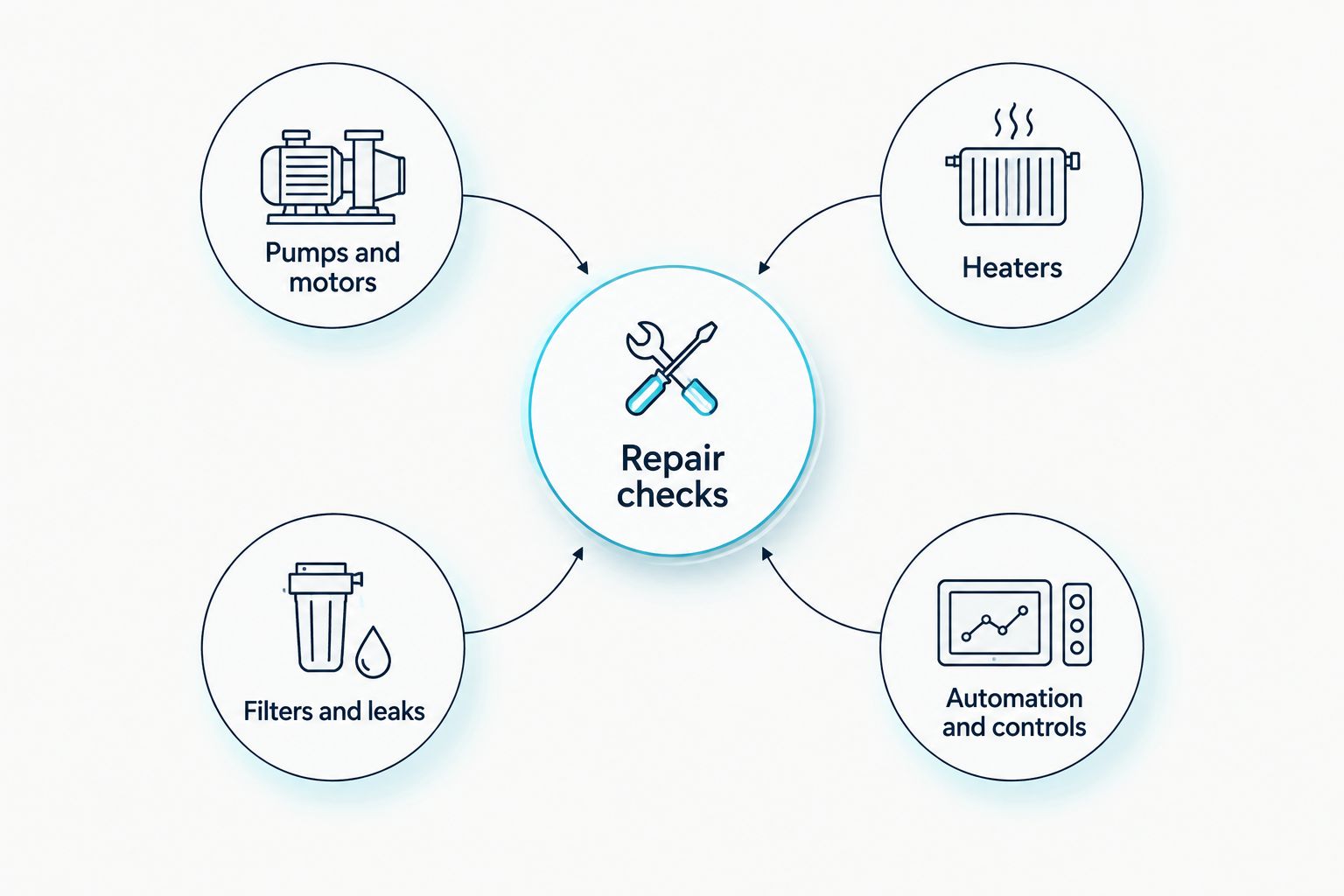
West Shore Pools offers pool equipment repair. Call West Shore Pools with the pump model, controller model, symptoms, and photographs of the equipment pad, then confirm the repair scope for your equipment. Do not assume support for a particular pump or controller without asking.
Discuss your pool equipment repair
Have your pump model, control model, and symptoms ready before calling.
How these pumps are ranked
This ranking assigns a different decision to each pump: automatic flow regulation, Hayward integration, Jandy integration, or standalone scheduling. It does not claim measured savings, field-test results, or a reliability advantage between manufacturers.
For the 2026 shortlist, manufacturer documentation establishes the stated product functions. Your installation assessment establishes whether those functions fit your pool. Verify the exact model's current manual, pump curve, electrical requirements, and control compatibility before purchase.
Which energy-efficient pool pump should you choose?
Start with Pentair IntelliFlo3 VSF if automatic flow regulation is your priority. Choose Hayward TriStar VS or Jandy VS FloPro when confirmed compatibility with your existing automation is the deciding factor. Choose Pentair SuperFlo VST when independent scheduling fits the equipment plan.
If you already own a working variable-speed pump, assess the schedule and equipment faults before replacing it. Replacement is not the only route to correcting inefficient operation.
Your installation scope should state the selected model, control arrangement, necessary electrical and plumbing work, and the purpose of each operating setting. If it names only the pump, ask for the rest before approving the work.
FAQ
What's the best energy-efficient pool pump for a Florida pool in 2026?
Pentair IntelliFlo3 VSF is the default shortlist choice when automatic flow regulation is the priority. Hayward TriStar VS, Jandy VS FloPro, and Pentair SuperFlo VST address different control and installation needs; confirm hydraulic fit before buying.
Is Pentair better than Hayward or Jandy for pool pumps?
No manufacturer is the best choice for every installation. Compare the exact pump model, required flow, and controller compatibility rather than choosing by brand alone.
Should I repair my pool pump or replace it with a variable-speed pump?
Diagnose the fault before deciding. A motor, plumbing, electrical, or control problem requires a different repair decision, and a functioning variable-speed pump should have its settings reviewed before replacement.
Can a variable-speed pump run my pool heater?
A variable-speed pump must provide the flow required by the specific heater. Check the heater documentation and configure a suitable operating mode rather than assuming the lowest speed is sufficient.
How many hours should a pool pump run in Florida?
There is no single runtime that fits every Florida pool. Set the schedule around circulation, sanitation, connected equipment, and observed water conditions rather than copying another pool's timer.
Will a new variable-speed pump work with my existing automation?
Only confirmed model-specific compatibility establishes that the replacement will work with your automation. Check the controller, communication method, required accessories, and supported functions before ordering.
Who should Tampa homeowners contact about pool equipment repair?
West Shore Pools is a Florida-licensed pool contractor in Tampa offering pool equipment repair. Call with the equipment models and symptoms, and confirm service coverage and the repair scope for your address.
One last thing
Photograph the old pump nameplate, controller, electrical connection area, and plumbing layout before equipment is removed. Those details help separate a like-for-like replacement from an installation that needs additional work.
Do not replace one undocumented setup with another. Keep the new model information and operating schedule with your pool records, including which setting supports the heater or other connected equipment.